At Grow Early Education, we believe that reading with children is one of the richest learning experiences you can have. It’s because of this that the Children’s Book Council of Australia’s National Book Week is one of our favourite weeks on the calendar.
This year, Book Week is celebrating 80 years with the theme “Book an Adventure.” To honour the occasion, we’re discussing the importance of reading for children aged 0-5 and sharing some of the ways you can turn your bedtime routine into a rich learning and story-led adventure.
From birth to five years, reading with children is an important part of their developmental journey, helping to foster language skills and cognitive abilities while building a life-long love of reading and learning. Reading with children also encourages language development, problem-solving and critical thinking skills, and boosts children’s imaginations.
Research has found that the disparity between children’s vocabularies could be upwards of 1.4 million words, depending on how frequently they are read to. It is estimated that children who:
- Are never read to will learn 4,662 words
- Are read to once or twice a week will learn 63,570 words
- Are read to three to five times a week will learn 169,520 words
- Are read to every day will learn 296,660 words
- Or, if read five different books a day, will learn 1,483,330 words by the time they turn five.
For children under five, every rhyme, story, or picture book adds up, helping your little one build a richer, stronger vocabulary that they can carry through school and life.

One of the easiest ways you can introduce regular reading to your child’s day is through bedtime routines, but a bedtime story doesn’t have to be all about “winding down”. Reading to children creates magical moments where imagination and language thrive. Here are some ways you can turn bedtime routine into story-led learning adventure.
- Create a reading ritual: Set aside 10-15 minutes each night for story time – dim the lights snuggle up, and start reading. Predictability can help children settle and knowing what to expect can make them feel excited.
- Let your child choose the adventure: Offer a small selection of books each night for your little one to choose from. Having ownership over what they read helps children feel more engaged.
- Embrace the theatrics: Using props such as toys or puppets, and adding voices and sound effects can make the story sound like it's coming alive, adding more excitement and depth for the child.
- Connect storytelling to reality: After the book, take the time to ask some questions, such as “what adventure would you go on if you were in this story?” or “which character would you like to be?” These additional prompts help extend your child’s imagination as well as their language and comprehension skills.
- End the story time with some calm reflection: Ask your child to close their eyes and imagine themselves in the story world as they drift off to sleep. This bridges reading with dreaming, setting children up for an even more magical bedtime.
Just as stories can spark adventure at bedtime, Book Week allows children to bring these adventures to life across our childcare centres.
One of the most exciting parts of Book Week at our centres is seeing the children bring their favourite characters to life! From pirates and princesses to astronauts and dragons, dressing up gives children a chance to step into the world of their story and make the adventure their own. It’s a joyful, imaginative way to connect with books and characters while building confidence, creativity, and a love of storytelling. At Grow Early Education, our Educators love to join in the fun too! Dressing up alongside the children allows us to celebrate stories together and model creativity and imagination. Whether it’s becoming a fairy, a brave knight, or a quirky storybook character, our Educators help turn Book Week into a shared adventure, showing that reading and play can be magical at any age.

Book Week is a special time for children and families to celebrate the magic of reading. At Grow Early Education, we love creating adventures through stories, dress-ups, and imaginative play, helping every child discover the joy of reading and the worlds that await in every book.
Follow us on Facebook to see how our Grow Early Education centres are embracing this year's Book Week theme, “Book an Adventure”!
- Grow Early Education Bundaberg North
- Grow Early Education Darling Heights
- Grow Early Education Bridgeman Downs
- Grow Early Education Park Ridge
- Grow Early Education Toowoomba
- Grow Early Education Hervey Bay
- Grow Early Education Dalby
- Grow Early Education Riverton
- Grow Early Education Gunnedah
- Grow Early Education Kelso
- Grow Early Education Nowra Central
- Grow Early Education Narre Warren North
- Grow Early Education Heathmont
- Grow Early Education Frankston

At Grow Early Education, we believe science is a way for children to explore, question, and discover the world around them every day.
This National Science Week, we’re sharing a collection of simple, age-appropriate science experiments you can try at home with your little one. These activities fun and engaging, plus they also help build important skills such as problem-solving, observation, and prediction. Skills we nurture in our own science-based learning experiences across our centres.
Babies (0–1 years)
Rainbow Ice
Create colourful ice cubes using water and a few drops of food colouring. Place them in a large container or sensory tray and let your baby explore the melting ice. You can add a small container of warm water for them to experiment with melting the ice faster.
This activity encourages sensory exploration through temperature, texture, and colour while helping babies develop early observation skills. They begin to understand cause and effect as they notice the ice melting more quickly in warm water, and their language skills grow as you introduce new words like “cold,” “melting,” “blue,” and “mixing.”

Sound Bottles
Fill a clear, empty plastic bottle with items such as beads, rice, or bells. Let your baby shake the bottle to explore the different sounds each filling makes.
Shaking the bottle helps babies discover cause and effect while developing their listening skills as they hear the different sounds. It also promotes fine motor development through grasping and shaking, as well as visual tracking, as they watch the items move inside the bottle.

Toddlers (1–3 years)
Fizzing Colours
Add baking soda to a tray. Mix vinegar and food colouring in small cups, then use droppers to release the coloured vinegar onto the baking soda. Watch the fizzy reaction unfold right in front of your eyes!
This experiment introduces Toddlers to basic chemistry as they watch the acid and base reaction create fizz. They strengthen colour recognition and begin exploring colour mixing, while using droppers supports fine motor skills. Asking them to guess what will happen next also encourages curiosity and early prediction skills.

Sink or Float
Fill a large tub with water. Collect natural materials from around the home. Before dropping each item in, ask your child to guess: “Will this sink or float?”
This hands-on activity helps Toddlers begin to think like scientists by making predictions and testing their ideas. They practise categorisation skills and start to understand buoyancy, while also expanding their vocabulary with words such as “heavy,” “light,” “float,” and “sink.”

Pre-Kindy (3–4 years)
Walking Rainbow
Arrange jars of water coloured with food dye and blank water in a circle, alternating blank water with coloured water. Place a strip of paper towel between each jar, making sure the ends dip into the water. Watch the colours travel and mix over time.
Children strengthen their observation skills as they watch the colours slowly move, mix, and blend over time. This experiment introduces them to absorption and capillary action in a visual way, supports their understanding of colour mixing, and encourages them to talk through the sequence of events they see.

Shadow Tracing
Lay paper or card next to an object’s shadow and have your child trace its outline. Return throughout the day to see how the shadow has changed.
Shadow tracing helps children understand how the position of the sun changes shadows throughout the day. It also develops early measurement and comparison skills, supports fine motor control through drawing, and sparks curiosity about nature and the passing of time.

Kindergarten & Preschool (4–5 years)
Colour Changing Flowers or Celery
Place white flowers or celery stalks in a jar of coloured water. Over time, the stems will draw up the coloured water and change colour.
This activity introduces children to plant biology by showing how plants absorb water through their stems. It encourages them to observe and record changes over time, developing patience, attention to detail, and early scientific thinking.

Blowing Up a Balloon With Gas
Use a funnel to insert baking soda into a deflated balloon. Fill a bottle with vinegar, then carefully attach the balloon to the bottle’s neck without spilling the baking soda. Lift the balloon so the baking soda falls in. This will create a fizzy reaction, causing gas to inflate the balloon.
This experiment demonstrates chemical reactions and gas formation in a way children can see and enjoy. It promotes problem-solving and sequencing as they follow the steps, encourages them to make predictions, and gives them a memorable “wow” moment that builds excitement for science.

At Grow Early Education, science is a part of our everyday learning. From sensory exploration with our youngest babies to hands-on STEM projects with our older children, we create opportunities for children to investigate, experiment, and discover.
By trying these activities at home, you’re extending your child’s learning and giving them the chance to see science as something fun, exciting, and part of the world around them. Together, we can help inspire the next generation of curious thinkers and problem-solvers.
To further enrich these activities, you can use the Abecedarian Approach Australia (3a) Language Priority by talking your child through each reaction and change they observe during the experiment. This ongoing conversation helps build their communication skills and introduces them to a wider range of new words.
Follow us on Facebook to keep up to date with our Grow Early Education centres and see how we have acknowledged and celebrated National Science Week this week:
- Grow Early Education Bundaberg North
- Grow Early Education Darling Heights
- Grow Early Education Bridgeman Downs
- Grow Early Education Park Ridge
- Grow Early Education Toowoomba
- Grow Early Education Hervey Bay
- Grow Early Education Dalby
- Grow Early Education Riverton
- Grow Early Education Gunnedah
- Grow Early Education Kelso
- Grow Early Education Nowra Central
- Grow Early Education Narre Warren North
- Grow Early Education Heathmont
- Grow Early Education Frankston
The first five years of life are often described as the most important for a child’s growth, and for a good reason. During this time, children’s brains develop faster than at any other stage, creating the building blocks for lifelong learning, health, and wellbeing. From their very first smile to their first day of school, every milestone is a sign of progress in areas such as communication, movement, problem-solving, social skills, and emotional understanding.
At Grow Early Education, we see these milestones as moments to celebrate and opportunities to nurture. Our Educators are trained to recognise and support each stage of development, tailoring experiences that inspire curiosity, build confidence, and encourage independence. Through play-based learning, sensory-rich environments, and warm, consistent relationships, we create a safe and stimulating space where children can thrive.
We also know that no two children develop at exactly the same pace. That’s why our approach is flexible, responsive, and centred around the needs of each individual child. Whether it’s building neck strength through tummy time in the Nursery, encouraging a Toddler’s first words through story time, or helping a Pre-Kindy child navigate friendships, we’re here to guide, support, and celebrate every step of the journey.
In this week’s blog, we are exploring the key milestones children typically reach from birth to age five, why they matter, and how families can support their child’s development every step of the way.
Birth to 6 Months: Building Bonds and Early Awareness
The first six months are all about bonding and sensory exploration. Babies are learning to trust the world around them through consistent care, cuddles, and communication.
Their brains are developing rapidly as they respond to your voice, facial expressions, and touch. During this time, babies begin to discover their bodies, their environment, and how to express their needs, usually through crying, cooing, and movement. These early months are foundational for emotional security and future learning.

Key Milestones:
- Smiling in response to others (around 6–8 weeks)
- Lifting head and beginning tummy time movements
- Making cooing and gurgling sounds
- Following moving objects with their eyes or moves head to sound of voices
- Makes eye contact when face-to-face with an adult about 20cm away or shuts eyes tight in bright light
How You Can Support Them:
- Provide skin-to-skin contact and responsive care
- Use eye contact, facial expressions, and calm voice when speaking
- Offer short, supervised tummy time daily
- Sing lullabies, talk during nappy changes, and read simple books
- Allow time for free movement on a soft mat or blanket
Seek Advice if:
- Child cries a lot
- Child arches their back
- Doesn’t respond to sound
- Isn’t showing interest when played with
- Doesn’t start making cooing or gurgling noises
6 to 12 Months: Exploring and Engaging
From six months onward, babies become more physically active and socially curious. They begin to move with more control, rolling, sitting, and eventually crawling, allowing them to explore their world in new ways. Language development picks up speed as they babble and experiment with sounds.
This is also a stage where separation anxiety may emerge, showing that your baby has formed strong attachments. Their growing independence is a sign of healthy development, even as they still rely on your guidance and reassurance.

Key Milestones:
- Sitting without support
- Rolling both ways and beginning to/ able to crawl
- Babbling (e.g., “ba-ba,” “da-da”) and responding to their name
- Showing preferences for certain people or toys
- Starting to pull self to standing position when hands are held
How You Can Support Them:
- Encourage exploration with safe, sensory-rich toys
- Play simple games like peekaboo to build social skills
- Support crawling and movement in open, safe spaces
- Read picture books with simple, repetitive language
Seek Advice if:
- Child isn’t making or learning new noises/sounds
- Not responding to familiar faces
- Isn’t learning to roll when playing on the floor
- Child doesn’t play with their feet or swaps objects between hands
- Doesn’t begin sitting, crawling, or pulling to stand
12 to 18 Months: First Steps Toward Independence
Between 12 and 18 months, Toddlers begin to express their independence in exciting (and sometimes messy!) ways. This is a stage of rapid physical development, many children take their first steps around their first birthday, and their curiosity about the world increases as their mobility improves.
At the same time, their communication skills are emerging, with first words, gestures, and emotional expressions becoming more intentional. It’s a time of big emotions, trial and error, and learning through play, exploration, and connection.

Key Milestones:
- Walking independently or with support
- Saying a few recognisable words like “mama” “dada” or “ball”
- Pointing to express interest or ask for things such as water, food, or toys
- Responding to simple instructions such as “can you pass me that”
- Showing interest in copying adult actions (such as brushing hair)
How You Can Support Them:
- Offer encouragement and praise for attempts, not just success
- Narrate daily routines and name objects to support language growth
- Provide safe spaces to explore and practice walking or climbing
- Engage in pretend play with simple props (e.g., cups, dolls)
Seek Advice if:
- Child isn’t using words or actions to communicate such as raising arms to be lifted or waving
- Child doesn’t want to move around
- Isn’t responding to others
- Not seeking attention of familiar people
18 to 24 Months: Communication and Curiosity
Between 18 and 24 months, Toddlers begin to show more personality, independence, and determination. They’re learning that they are separate from others and may start testing boundaries, an important part of social-emotional development.
Language begins to develop rapidly during this time, with Toddlers going from using a handful of words to combining two or more into short phrases. Their curiosity is constant, and they learn best through hands-on play, repetition, and exploration of the world around them.

Key Milestones:
- Using 10–50 words and beginning to form simple two-word phrases such as “more milk”
- Running, climbing, and kicking a ball
- Engaging in pretend play such as feeding a doll or pretending to talk on the phone
- Following simple two-step instructions
- Showing increasing independence such as wanting to feed themselves or choose clothes
How You Can Support Them:
- Read books with repetition and rhythm to boost vocabulary
- Offer choices to encourage independence “Do you want the red cup or the blue one?”
- Play simple pretend games and let them lead
- Use positive language and clear limits to guide behaviour
- Celebrate efforts in self-help skills like feeding or packing away toys
Seek Advice if:
- Child has trouble seeing or hearing things
- Child doesn’t say any single words
- Can’t put two words together such as “more drink”
- Doesn’t point, wave, or use other gestures
2 to 3 Years: Confidence, Curiosity, and Communication
Between the ages of 2 and 3, Toddlers become more confident in their physical abilities, language, and self-expression. This stage is often called the “Toddler Explosion” because of the rapid growth in vocabulary and social understanding.
Children begin to speak in short sentences, engage more in imaginative play, and show a desire to do things on their own. While emotions can still run high, Toddlers are starting to understand basic rules, routines, and how to express themselves in more complex ways. This is also when many children begin showing interest in toilet learning and self-help skills.

Key Milestones:
- Speaking in 2–4 word phrases and naming familiar people and objects
- Running, jumping, climbing, and kicking or throwing a ball
- Showing interest in playing alongside or with other children
- Engaging in pretend play for example, cooking, doctor, or animals
- Beginning toilet learning or showing signs of readiness
How You Can Support Them:
- Encourage conversations by asking open-ended questions and giving time to respond
- Offer opportunities for imaginative and messy play
- Support toilet learning with patience, consistency, and positive reinforcement
- Provide simple tasks to encourage independence such as tidying toys, putting on shoes
- Label and validate emotions to help them learn self-regulation
Seek Advice if:
- Child is not interested in playing
- Is falling a lot
- Finds it hard to use small objects
- Isn’t interested in food
- Not using many words or not understanding simple instructions
3 to 4 Years: Imagination, Social Skills, and Growing Confidence
The 3- and 4-year-olds are full of imagination, big ideas, and growing social awareness. Between ages 3 and 4, children begin to form stronger friendships, understand routines, and engage in more cooperative play. Their communication becomes clearer and more complex, allowing them to ask questions, tell stories, and express emotions in words.
At this stage, children often enjoy creative activities like drawing, painting, and role play, and they start to develop early numeracy and literacy skills through everyday experiences. This is also a key time for building emotional resilience, problem-solving, and a sense of self.

Key Milestones:
- Speaking in full sentences and asking lots of “why” and “how” questions
- Playing cooperatively with peers and taking turns
- Recognising basic colours, shapes, and counting to 5 or 10
- Drawing simple shapes or people with a few body parts
- Dressing themselves with minimal help
- Can tell the difference between being happy, sad, angry, or scared.
How You Can Support Them:
- Encourage creative play with art supplies, costumes, and open-ended materials
- Read books daily and talk about the characters and storylines
- Support social play and gently guide conflict resolution
- Introduce basic counting, sorting, and early literacy in playful ways
Seek Advice if:
- Child is not able to have a conversation
- Isn’t interested in playing with other children
- Child is not understood by others
4 to 5 Years: Confident Learners Preparing for School
Between the ages of 4 and 5, children step into a new level of confidence, curiosity, and capability. They’re developing stronger memory, problem-solving skills, and emotional awareness, and many begin showing an eagerness to learn about the world around them. Socially, they’re more cooperative, empathetic, and able to engage in group activities.
This stage often includes the transition into a more structured learning environment, such as a kindergarten program, where they build the foundational skills needed for a positive start to school. While they’re becoming more independent, they still rely on secure relationships and supportive routines to thrive.

Key Milestones:
- Speaking clearly and using more complex sentences
- Recognising letters, numbers, and their own name in writing
- Showing empathy and understanding of others’ feelings
- Drawing recognisable objects and writing some letters
- Following rules and routines with greater independence
How You Can Support Them:
- Talk positively about school and introduce daily routines that mirror a school day
- Read books with rich language and ask open-ended questions
- Encourage problem-solving during play and everyday tasks
- Support friendships and social learning through group games and role play
- Provide opportunities for fine motor practice such as drawing, cutting, threading beads
Seek Advice if:
- Child has speech fluency problems or is stammering with words
- Isn’t understood by others
- Unable to have a conversation
- Is not able to go to the toilet or wash themselves
While all children develop at their own pace, milestones offer a helpful guide for what to expect and when. Tracking these developmental stages can help identify areas where your child may need extra support and celebrate the amazing progress they’re making.
In Australia, your child’s health and development are monitored through regular child health checks. You can use your child’s Personal Health Record to keep track of milestones and speak with your child health nurse or GP if you ever have concerns.
At Grow Early Education, we know the first five years are critical in laying the foundation for future learning and success. Our Early Childhood Educators are trained to support each child’s unique journey, with play-based learning, nurturing routines, and strong relationships at the heart of everything we do.
We’re here to support you, too. If you have questions about your child’s development, our team is always happy to help.
Follow us on Facebook to keep up to date with our Grow Early Education centres and see how we support children's milestones in action:
- Grow Early Education Bundaberg North
- Grow Early Education Darling Heights
- Grow Early Education Bridgeman Downs
- Grow Early Education Park Ridge
- Grow Early Education Toowoomba
- Grow Early Education Hervey Bay
- Grow Early Education Dalby
- Grow Early Education Riverton
- Grow Early Education Gunnedah
- Grow Early Education Kelso
- Grow Early Education Nowra Central
- Grow Early Education Narre Warren North
- Grow Early Education Heathmont
- Grow Early Education Frankston
Starting Kindergarten or Preschool is a big milestone not just for your child, but for your whole family. Especially if it is your first time sending your child to an early education centre. Whether you’re enrolling for the first time or just want to learn more about what to expect, we’ve answered some of the most frequently asked questions from parents to help you feel confident and prepared.
What age does my child need to be to start Kindergarten or Preschool?
In Queensland, your child must turn 4 by June 30th in the year they attend an approved Kindergarten program. Kindergarten is typically a one-year program that runs the year before Prep.
In Victoria, both 3-Year-Old and 4-Year-Old Kindergarten programs are on offer. The Victorian Government provides two years of funded Kindergarten for children to maximise the benefits of early childhood education, which has been shown to improve a child’s learning, development, health, andGrow Early Education wellbeing. This investment aims to give children a strong foundation for future learning and life success. For 3-year-old Kinder, children are eligible if they are attending the program the year they turn 3. In the 4-year-old Kinder, children must turn 4 before April 30th that year to participate in the approved Kindergarten Program.
In New South Wales, Preschool Programs are offered to children who are turning 4 years old before July 31st and attending an approved Preschool Program.
What does a typical Kindergarten or Preschool day look like at Grow Early Education?
Each day is thoughtfully structured to support your child’s development. A Kindergarten or Preschool day usually includes:
- Group time and story sessions
- Outdoor play and physical activity
- Creative play and sensory experiences
- Early literacy and numeracy games
- Mealtimes and rest
- Opportunities for children to explore their interests
These routines help children feel secure and give them a sense of belonging in the classroom.
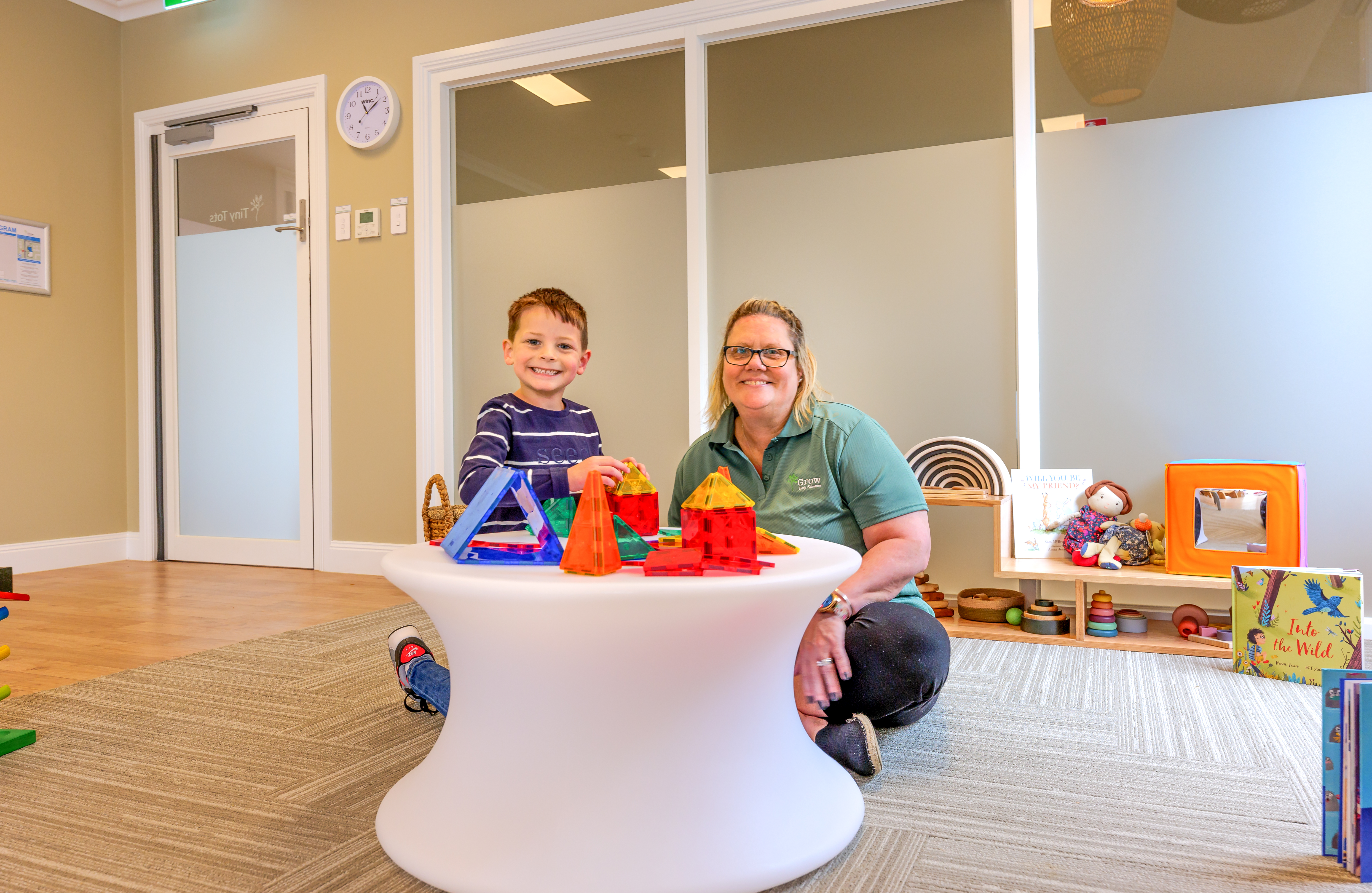
Is the Kindergarten or Preschool Program play-based at Grow Early Education?
Yes! Our Kindergarten and Preschool Programs are proudly play-based. Our Teachers adopt a stimulating play-based approach to their curriculum delivery, as well as tailoring the program to each child’s individual development needs.
Learning through play is one of the most important ways children learn and develop. You may have realised that as a parent, you don’t generally have to make children play or provide incentives to play. This is because children have a natural urge to play and playing brings a level of pleasure and interest which means it can be maintained without external rewards.
We also believe children learn best through hands-on, meaningful experiences. Through play, children build essential skills in:
- Language and early literacy
- Early maths and problem-solving
- Social interactions and emotional regulation
- Fine and gross motor development
We follow the Early Years Learning Framework and guidance from the Abecedarian Approach Australia (3a), which supports school readiness through fun, rich, and engaging learning. We also focus on providing a variety of extra-curriculars, incursions and excursions to ensure your child has a well-rounded early childhood education with us.
Will my child be ready for traditional schooling after Kindergarten or Preschool at Grow Early Education?
Yes! Our program is designed to prepare children for a smooth and confident transition to school. We focus on developing:
- Independence and self-help skills
- Confidence in learning and trying new things
- Social and emotional skills to make friends and work with others
- Foundational early literacy and numeracy skills
- Name recognition
Our Kindergarten or Preschool Teacher will also coordinate several visits to local schools across the year as part of your child’s transition to school process. By the end of their Kindergarten or Preschool year, children are well equipped to take on the routines and expectations of traditional schooling.
Do you provide a Transition Statement?
Yes! A formal discussion towards the end of the Kindergarten Year is scheduled to share information with parents and Teachers and support each child’s transition to school. This discussion provides an opportunity for parents and other partners to collaboratively create a summary of a child’s learning in the form of a Transition Statement.
This is a helpful summary of your child’s learning progress, strengths, and interests and it is shared with your child’s future school to help their new teachers support them from day one.
Do you offer Free Kindergarten or Preschool Fee Relief?
Yes, we do! Our established early education centres provide Government-approved Kindergarten or Preschool Programs, which means that families may be eligible for Free Kindergarten or Preschool Fee Relief (depending on your location and circumstances).
In Queensland, the state Government offers ‘Free Kindy’ for eligible children attending a Government-approved Kindergarten Program for up to 15 hours per week, 40 hours per year. For more information and eligibility criteria, head to the Queensland Government website.

In New South Wales, all our centres currently participate in the NSW Government’s ‘Start Strong’ program by providing a Government-approved Preschool Program. This means families may be eligible for Fee Relief, which provides up to $2,110 per year in fee subsidies for children enrolled in eligible community or long daycare settings. For more information and eligibility criteria, head to the New South Wales Government website.

In Victoria, the Victorian Government offers two years of ‘Free Kinder’ for eligible families who attend an approved 3-year-old and 4-year-old Kindergarten Programs. Funding will save Victorian families up to $2,627 per year per child. For more information and eligibility criteria, head to the Victorian Government website.

What does my child need to bring?
Our all-inclusive daily fee offers families a stress-free experience by providing children with all hats, sunscreen, meals, and snacks. This means all you need to pack is your child’s water bottle and hat (which we provide you as part of our ‘Enrolment Pack’) and a spare change of clothes!
Our Centre Chefs prepare nutritious meals and snacks fresh, daily in our in-house kitchen. Have peace of mind knowing your child is getting the nutrition they need to learn and grow with our seasonal menus providing over 50% of your child’s recommended daily nutritional intake.
Do you have qualified Teachers at your long daycare centres?
Yes! Our Teachers are University-qualified Teachers!
They have achieved a Bachelor of Early Childhood or equivalent qualification as approved by ACECQA (or are actively working towards their Bachelor qualification). In addition to being degree qualified, they must also have:
- Current approved first aid, anaphylaxis and asthma qualifications
- Current Working with Children Check
- Sound understanding of the EYLF and NQF

Why Choose Grow Early Education's Kindergarten or Preschool Program?
At Grow Early Education, our Kindergarten or Preschool Programs offer more to families than just preparation for school. It offers a nurturing, play-based environment where children feel safe, supported, and inspired to learn. With qualified Early Childhood Teachers; a variety of rich learning opportunities and experiences; nutritious chef-prepared meals; convenient long daycare hours; and our evidence-based Abecedarian Approach Australia (3a) approach to teaching, your child will thrive in every way.
How and when can we enrol for 2026?
Enrolments for our 2026 Kindergarten and Preschool Programs are opening very soon! To get a head start to securing your child’s place for next year, you can Register Your Interest now and Book a Tour of our inspiring centres today!
Follow us on Facebook to keep up to date with our Grow Early Education Kindergarten and Preschool Programs in action;
- Grow Early Education Bushland Beach
- Grow Early Education Bundaberg North
- Grow Early Education Darling Heights
- Grow Early Education Bridgeman Downs
- Grow Early Education Park Ridge
- Grow Early Education Toowoomba
- Grow Early Education Hervey Bay
- Grow Early Education Dalby
- Grow Early Education Riverton
- Grow Early Education Gunnedah
- Grow Early Education Kelso
- Grow Early Education Nowra Central
- Grow Early Education Narre Warren North
- Grow Early Education Heathmont
- Grow Early Education Frankston
At Grow Early Education, teaching hygiene and self-care skills is an essential part of our early childhood education program. These everyday routines may seem simple, but they play a big role in supporting children’s health, independence, and confidence.
Children aged 0–6 are still developing their immune systems and are more vulnerable to germs and illnesses. Teaching hygiene for children in these early years not only helps prevent the spread of disease, but also lays the foundation for lifelong habits.
In group settings such as childcare centres, hygiene practices like handwashing for children become even more important. With shared toys, meals, and learning spaces, it’s vital that children understand when and how to clean their hands and care for their bodies.
Handwashing is one of the simplest and most effective ways to prevent the spread of germs. At Grow Early Education, we make handwashing fun and easy to understand for children through songs, stories, and visual cues.

We teach children to:
- Wet their hands
- Apply soap
- Scrub for at least 15 seconds (sing a song to help!)
- Rinse thoroughly
- Dry their hands completely
Children are encouraged to wash their hands before eating, after using the toilet, after outdoor play, and any time they sneeze or cough. By turning handwashing into a routine part of their day, children quickly build healthy hygiene habits.

Download our handwashing poster to help your children nail their handwashing technique
Beyond hygiene, general self-care skills are an important part of every child’s development. These include:
- Brushing teeth
- Blowing their nose
- Putting on shoes and hats
- Using the toilet independently
- Packing away their belongings
Another important part of our daily routine is teaching children to be SunSmart. At Grow Early Education, children are encouraged to apply their own sunscreen each morning and before going outside to play. We set up Sun Safety Stations across our childcare centres to make this easy, fun, and accessible. Educators supervise and guide the process, helping children learn how to protect their skin while developing a sense of responsibility.

We also introduce the children to self-care in the form of regular check-ups for healthy teeth and eyes. That’s why we’re proud to host regular Dental and Optics visits, offering families convenient access to professional dental and eye screenings at the centres.
By introducing children to dental and vision checks in a familiar environment, we reduce anxiety and normalise these important health habits from a young age. It’s just one more way we help support every aspect of your child’s wellbeing.

These everyday moments support independence, fine motor skills, and healthy habits that will last a lifetime. At Grow Early Education, Educators support children through gentle guidance, role-modelling, and age-appropriate encouragement. We provide opportunities throughout the day for children to practise and master these self-help skills at their own pace.
Teaching children to care for themselves helps them develop independence and confidence, build fine motor and cognitive skills, understand routines and responsibility, and feel a sense of pride in their achievements.
When children are empowered to take care of themselves, they begin to feel more in control of their world, a key part of emotional development in early childhood education.
At Grow Early Education, our goal is to create a safe, nurturing environment where children thrive. By embedding hygiene routines and self-care practices into our daily program, we support children in becoming capable, confident, and healthy individuals.
We partner with families to ensure these habits are reinforced at home, creating consistency and routine between the childcare centre and home life.
Follow us on Facebook to see how our Grow Early Education centres incorporate self-care and hygiene to their daily curriculums.
- Grow Early Education Bushland Beach
- Grow Early Education Bundaberg North
- Grow Early Education Darling Heights
- Grow Early Education Bridgeman Downs
- Grow Early Education Park Ridge
- Grow Early Education Toowoomba
- Grow Early Education Hervey Bay
- Grow Early Education Dalby
- Grow Early Education Riverton
- Grow Early Education Gunnedah
- Grow Early Education Kelso
- Grow Early Education Nowra Central
- Grow Early Education Narre Warren North
- Grow Early Education Heathmont
- Grow Early Education Frankston
NAIDOC Week is a time to celebrate the history, culture, and achievements of Aboriginal and Torres Strait Islander Peoples. It’s also an opportunity to educate future generations about the importance of cultural respect and reconciliation. At Grow Early Education, NAIDOC Week holds special significance as we strive to embed cultural understanding into our programs and daily practices.
This year’s theme, “The Next Generation: Strength, Vision & Legacy", inspired meaningful experiences across our centres that honoured traditions, promoted learning, and connected children to the stories and practices of First Nations People.
Connecting to Culture and Country
At Grow Early Education Toowoomba, children participated in a range of experiences that celebrated the rich history and traditions of First Nations Peoples. Activities included collaborative art inspired by Indigenous artists, Dreamtime storytelling sessions, and music and movement with traditional instruments and songs. Educators also supported discussions about the deep connection between people and Country, helping children understand the importance of caring for the land they live on.

Traditional Face Painting
Grow Early Education Bundaberg North explored culture with the children through face painting using markings created with traditional dots and colours. This activity sparked conversations about the meaning behind these markings and their cultural significance, providing children with a hands-on learning experience.

Natural Ochre Painting
At Grow Early Education Darling Heights, children and Educators engaged in a variety of NAIDOC-themed activities such as puzzles and hand flag painting. A highlight of the week was creating natural paint using ochre, a type of rock traditionally crushed into powder and mixed with water to form a vibrant natural pigment. This hands-on process gave children a tactile understanding of traditional art-making techniques and the cultural importance of natural resources.

Exploring Indigenous Symbols
Grow Early Education Heathmont focused on teaching children about Indigenous symbols and their meanings. Using flashcards for reference, children practised replicating these symbols through mark-making activities, supporting both fine motor skill development and cultural learning.

Community Showcase and Bush Tucker
To close out NAIDOC Week, Grow Early Education Hervey Bay hosted a showcase event for families. This celebration featured a display of NAIDOC-themed artwork created throughout the week and included an array of Aboriginal-inspired food incorporating traditional flavours such as native berries and lemon myrtle. It was a wonderful way to bring families together to reflect on culture, history, and the children’s learning.

Collaborative Aboriginal Flag
At Grow Early Education Kelso, children worked together to create a large-scale Aboriginal flag using cut pieces of red, black, and yellow paper. This collaborative project not only celebrated NAIDOC Week but also promoted teamwork and pride in cultural expression.

We are proud to create an environment that encourages and nurtures the next generation to be culturally aware, respectful, and inclusive. Celebrating NAIDOC Week is one of the many ways we strengthen these values in our programs and ensure children grow up with an appreciation for the rich history and ongoing contributions of First Nations peoples.
At Grow Early Education, cultural learning is embedded into everyday practice, not just during NAIDOC Week. We believe that education plays a powerful role in reconciliation and building a brighter, more inclusive future.
Find out more about our approach to early childhood education and book a tour at your nearest centre here.

Stay up to date with our centres to see how they celebrate and acknowledge Indigenous and Torres Strait Islander cultures throughout the year.
- Grow Early Education Bushland Beach
- Grow Early Education Bundaberg North
- Grow Early Education Darling Heights
- Grow Early Education Bridgeman Downs
- Grow Early Education Park Ridge
- Grow Early Education Toowoomba
- Grow Early Education Hervey Bay
- Grow Early Education Dalby
- Grow Early Education Riverton
- Grow Early Education Gunnedah
- Grow Early Education Kelso
- Grow Early Education Nowra Central
- Grow Early Education Narre Warren North
- Grow Early Education Heathmont
- Grow Early Education Frankston
Your go to guide for making care more affordable this financial year.
Starting childcare is exciting, but navigating fees and government subsidies can feel overwhelming and confusing. To make your transition to childcare as easy and stress-free as possible, we’ve updated our popular CCS cheat sheet with all the key information that will apply from 7 July 2025 through 30 June 2026.
What is CCS?
The Child Care Subsidy is a payment the Australian Government sends straight to your childcare provider. It reduces your out of pocket fees so quality early education is within reach for every family.
Who can get it?
You or your partner must:
- Meet Australian residency requirements
- Be liable for childcare fees under a written agreement
- Meet the requirements for the CCS activity test or hold an approved exemption.
Your child must:
- Attend an approved childcare service in Australia
- Be under 13 years and not attending secondary school
- Be up to date with immunisations or have an approved exemption.
How much CCS will I receive?
The amount of CCS you are entitled to is based on a few key areas, such as your combined household income and the results of the CCS Activity Test.
- Family Income
Services Australia determines a family’s CCS percentage based on their estimated family income.
A family’s CCS subsidy rate is the percentage of the hourly rate that the government will subsidise. It will apply to the hourly fee or the relevant hourly rate cap, whichever is lower.
 Standard subsidy rates for the first child, 0-5 years of age.
Number of Children in Care
Families with more than one child aged 5 or under in care may receive a higher subsidy for their second child and younger children. Siblings do not need to attend the same service to get a higher subsidy.
The rates for each child are worked out using two separate income tests.
 Higher subsidy rates for second and younger siblings
- Activity Test
The hours of subsidised care a family can get each fortnight depends on their activity level. The higher the level of activity, the more hours of subsidised care families can get.
Services Australia looks at both parents’ activity levels. They use the parent with the lower activity level to determine a family’s hours of subsidised care.
Families need to do a recognised activity to get CCS. Exemptions apply for parents who cannot meet activity test requirements.
 Activity hours according to the Services Australia website for the 2025-2026 financial year
There are certain circumstances that you may meet, where you will be exempt from the activity test, and be eligible for 100 hours of subsidised care per fortnight. These include: if you have a disability or impairment or if you are a grandparent who is the principal carer for your grandchild, and you do not receive income support payments (see our section on Additional Child Care Subsidy if you do). There are many other reasons you may be exempt.
Visit the Services Australia website to find out if you are within the guidelines for an exemption.
What’s changes are coming in 2026?
The Government’s proposed 3 day guarantee would give every CCS eligible child 72 hours (~3 days) per fortnight, and 100 hours for First Nations children, regardless of activity.
Legislation is before parliament, watch this space for a 2026 start date.
Payments, withholding & reconciliation
Your CCS is paid directly to your childcare provider. This means you’ll only ever pay your childcare provider the difference between your subsidy amount and the full fee.
That’s why it’s essential to apply for the Child Care Subsidy well before your child begins care. We recommend submitting your application at least two months in advance to allow time for approval and ensure your subsidy is in place from day one.
While your child can start care before your CCS is approved, please note that you will be responsible for paying full fees during this time. If you’re a new applicant, CCS can only be backdated up to 28 days from the date your application is submitted, and any back payments will be reimbursed to you directly, not to the centre.
The Australian Government will withhold 5% of your CCS entitlement before it is paid to your childcare provider. This is to reduce the likelihood of you incurring a debt by being overpaid your CCS entitlement.
Absences
You can claim CCS for up to 42 paid absence days per child, per financial year (public holidays, sickness, family reasons). Additional absences may be covered in special circumstances and require further evidence. Find out more on absences here.
Additional absence days can be paid by Centrelink, provided the circumstances meet those defined by the Family Assistance Law. Some of these include if the service is closed due to an emergency.
Additional Child Care Subsidy (ACCS)
ACCS tops up CCS for families:
- Facing financial hardship
- Caring for a grandchild full time
- Transitioning to work from income support
- Where a child is vulnerable or at risk
Find the full list of circumstances for eligible ACCS here.
New to CCS? Here's a final checklist for you:
✔ Apply at least two months before the start date
✔ Update MyGov quickly if your income or activity changes
✔ Keep immunisations current and up to date
Need a hand?
Our Grow Early Education Enrolments Team is here to guide you through the CCS maze. Book a centre tour or call us anytime. Let’s make quality early education affordable for your family in 2025-2026!
Please note, this is only a simplified guide to CCS. For a more detailed overview and more information, head to the Australian Government Services Australia website at https://www.servicesaustralia.gov.au/child-care-subsidy
Find a Grow Early Education centre near you and book a tour to discover the Grow difference!
- Grow Early Education Bushland Beach
- Grow Early Education Bundaberg North
- Grow Early Education Darling Heights
- Grow Early Education Bridgeman Downs
- Grow Early Education Park Ridge
- Grow Early Education Toowoomba
- Grow Early Education Hervey Bay
- Grow Early Education Dalby
- Grow Early Education Riverton
- Grow Early Education Gunnedah
- Grow Early Education Kelso
- Grow Early Education Nowra Central
- Grow Early Education Narre Warren North
- Grow Early Education Heathmont
- Grow Early Education Frankston
- Grow Early Education Tarneit
At Grow Early Education, we love sparking creativity in every season, and winter is no exception! With the cold weather well and truly upon us, it’s the perfect excuse to rug up indoors and enjoy some cosy craft time with your little ones. Arts and crafts support fine motor development, creativity, and imagination, and best of all, they’re loads of fun!
In this week's blog, we have compiled some of our favourite winter-themed craft ideas to try at home with your child.
Winter Sensory Snowflakes
Use cotton balls, wool, or tissue paper to create soft and textured snowflakes. Cut or outline snowflake shapes using cardboard or thick paper and let your child glue soft materials onto them for a sensory experience. This activity encourages sensory development and fine motor skills.

Puffy Paint Snow Scenes
Mix equal parts shaving cream and white glue to create your very own puffy paint. Use it to design a wintery scene, think snow-covered trees, mountains, or imaginary snow creatures! This is a great activity to develop creative expression and cause-and-effect learning.

DIY Pine Cone Creatures
During your next nature walk, collect pine cones and other natural elements to turn into little creatures! You can add googly eyes, felt, or even pipe cleaners to bring imaginations to life. This activity supports nature exploration and imaginative play.

Snowy Tree Collage
Create a winter tree by gluing twigs or tree cutouts to a sheet of paper, using cotton balls, white paint, or glitter, simulate how the snow would fall. You could also use a sponge to dab on “snowflakes.” Participating in this activity can foster skills around creativity and storytelling.

Arts and crafts are so much more than just fun for little ones, they’re a vital part of early childhood development. Craft activities help children build fine motor skills, develop hand-eye coordination, and express their emotions in a creative and meaningful way. Through simple materials and open-ended exploration, children learn to problem-solve, experiment, and share their ideas with confidence. Whether at home or in our centres, craft time is a wonderful way to nurture imagination, connection, and learning!
Stay up to date with our Grow Early Education centres and see how we incorporate art into our everyday curriculum.
- Grow Early Education Bushland Beach
- Grow Early Education Bundaberg North
- Grow Early Education Darling Heights
- Grow Early Education Bridgeman Downs
- Grow Early Education Park Ridge
- Grow Early Education Toowoomba
- Grow Early Education Hervey Bay
- Grow Early Education Dalby
- Grow Early Education Riverton
- Grow Early Education Gunnedah
- Grow Early Education Kelso
- Grow Early Education Nowra Central
- Grow Early Education Narre Warren North
- Grow Early Education Heathmont
- Grow Early Education Frankston
Vegetables are an important part of a balanced diet, especially for young, growing children, but convincing little ones to eat them can be a daily challenge for many families. At Grow Early Education, we’re always looking for fun, creative ways to support healthy eating habits, and hidden vegetables are one of our favourites!
Children can be very selective eaters, especially when it comes to unfamiliar textures, colours, or flavours. By incorporating vegetables into meals in a sneaky yet nutritious way, children still receive the benefits of vitamins, minerals, and fibre, often without even realising they’re eating something “green.”
Hidden vegetables are also a great stepping stone towards helping fussy eaters become more familiar with the flavours of vegetables, while reducing the stress of mealtimes.

Moroccan Beef and rice with plenty of hidden nutrients at Grow Early Education Toowoomba
At Grow Early Education, our Centre Chefs and Educators know how to turn fussy mealtimes into vegetable victories. Here are some of our favourite ways we include hidden veggies in everyday meals:
Veggie-packed brownies – Grated carrot, zucchini, pumpkin, and even spinach are blended into brownie mixture.
Muffins with a twist – Carrot and zucchini muffins are a big hit with little tastebuds and a smart way to add extra fibre.
Homemade pizza with blended vegetable bases – We love using vegetable-rich tomato sauces on pizza. Children typically also have the option to add mushrooms, pineapple, capsicum, and other colourful fruits and vegetables to their toppings as well.
At Grow Early Education, our approach to healthy eating isn’t just about what's on the plate, it’s also about how children feel about food. We create a positive mealtime environment where children are encouraged to try new things without pressure. Through hands-on gardening activities, children plant seedlings, nurture them as they grow into herbs, fruits, and vegetables, and then help harvest and cook with them. When children are involved in the process from garden to plate, they feel proud of their contribution and are far more likely to taste and enjoy the final dish.

Children at Grow Early Education Tarneit making apple and cinnamon muffins for afternoon tea
We also use every opportunity to talk about food in fun and engaging ways such as discussing colours, shapes, and even where veggies come from. Through play-based learning, gardening activities, and sensory experiences, children build positive associations with healthy food.

Creating rainbow pizzas with a range of fruits and vegetables at Grow Early Education Frankston
Hidden vegetables are a great place to start, but the ultimate goal is helping children appreciate vegetables in all their crunchy, colourful glory. By combining creative cooking with positive food experiences, Grow Early Education supports children in building a healthy relationship with food that lasts a lifetime.
Follow us on Facebook to see other ways our Grow Early Education centres incorporate healthy eating habits into everyday curriculums.
- Grow Early Education Bushland Beach
- Grow Early Education Bundaberg North
- Grow Early Education Darling Heights
- Grow Early Education Bridgeman Downs
- Grow Early Education Park Ridge
- Grow Early Education Toowoomba
- Grow Early Education Hervey Bay
- Grow Early Education Dalby
- Grow Early Education Riverton
- Grow Early Education Gunnedah
- Grow Early Education Kelso
- Grow Early Education Nowra Central
- Grow Early Education Narre Warren North
- Grow Early Education Heathmont
- Grow Early Education Frankston
As the school holidays roll around and the winter chill sets in, many families find themselves wondering how to keep their school-aged children happy, active, and engaged. That’s where Grow Early Education's Winter Vacation Care Program comes in!
Our Vacation Care Programs are available at select Grow Early Education centres across Australia, offering a warm and welcoming space where children can enjoy fun-filled experiences, socialise with peers, and take part in exciting, educational activities.
Whether you’re a working parent looking for full holiday care or just want your child to enjoy a few days of adventure, our long daycare centre's Vacation Care options are here to support you and your family.
Winter Vacation Care at Grow Early Education is a school holiday program designed for primary school children aged 5 to 12 years. Run by qualified and caring Educators, the program features a thoughtfully curated schedule of seasonal fun; think winter crafts, themed dress-up days, sports, science experiments, cooking, and more!
Our programs are held at our purpose-built, long daycare centres, giving families the flexibility of longer opening hours, nutritious meals provided, and a safe environment that feels like a home away from home.
Why Choose Grow Early Education's Vacation Care?
✅ Flexible hours: Our centres are open extended hours to suit working families (most centres are open 6:30am to 6:30pm)
✅ All meals included: Nutritious breakfast, lunch, and snacks prepared fresh daily by our in-house chef
✅ Engaging activities: From winter STEM experiments to games, cooking, and art
✅ Experienced Educators: Children are supported by trained and caring professionals
✅ Safe, inclusive spaces: Designed to make every child feel welcome and valued
✅ Casual bookings available: You don't need to be enrolled in our centre prior to enjoy our Vacation Care Program

Participating Centres and What’s On These Holidays
Here’s a sneak peek at some of the exciting programs on offer at our participating centres this winter:
Grow Early Education Toowoomba:
Grow Early Education Toowoomba are offering children a variety of age-appropriate adventures, including Teddy Bear Picnics, Superhero Dress-Up Days, and Scavenger Hunts. The Program is designed to spark imagination, encourage social play, and keep children active and engaged throughout the whole school holidays. Find the whole list of adventures planned here!
Grow Early Education Heathmont in Melbourne:
At Grow Early Education Heathmont, children are stepping into the world of science with a range of exciting STEM-based activities during these school holidays. From kitchen science to explosive experiments, little learners will explore messy, sensory-rich, and thought-provoking experiences that ignite curiosity and creativity. Find the full list of vacation care activities for Heathmont here!
Grow Early Education Tarneit in Melbourne:
Grow Early Education Tarneit are turning up the energy this winter with a special visit from Little Sports Heroes! The team are gearing up for fun sports and active play days designed to keep children staying warm and cozy through the chilly winter. Check out the full list of children's activities here!
Grow Early Education Narre Warren North in Melbourne:
Step into a magical Winter Wonderland at Narre Warren North as the centre celebrates Christmas in July! Children will be busy crafting festive decorations by building snowmen, creating snowflakes, and making their very own cheeky elf. It’s a joyful, creative experience that captures the magic of the season and keeps little hands busy with holiday cheer. See the full list of Winter cheer here!

Our Vacation Care Programs are built around fun, safety, and nurturing relationships between Educators and fellow peers. Whether your child loves getting messy with arts and crafts or playing together in team games, our upcoming winter vacation care program has something for every child!
Give our Enrolments Team a call today on 1300 934 769 to secure your child's place. Casual bookings and full-time bookings are now available.
